Saturday, September 5, 2015

9/5/15 - Blast From the Past . . . This Is Why I Teach Math!!


The primary roadblock for student success in mathematics is a lack of self-confidence.  Many students see themselves as missing some innate skill necessary for math success and are powerless to change it.  Parents and other adults reinforce this fixed mindset with phrases like, “I was never good at math” and “I’m not a math person.”  These simple phrases have devastating consequences.  Students believe there are those who get math and those who do not and no amount of studying will change that fact. As a teacher, I take on a variety of roles, but my most important role is cheerleader.  Offering continued encouragement, communicating clearly and sincerely that I believe in them, is the most essential thing I can do to change this mindset.  One way I do this is by seeking out students to share problem-solving strategies.  Allowing students to share a variety of methods encourages students to experiment with different strategies, even when they do not feel completely confident. 

Students who struggle with math see it as a confusing jumble of numbers and letters, abstract ideas with no connection to the real world.   Providing opportunities for students to make those connections reinforces the concrete nature of math.  At the end of a unit focusing on area, volume and surface area, I collaborated with Aida Jarrett and Julie Barker-Rachow, two amazing educators with a real passion for teaching and learning. Together, we created a series of stations with a geometry focus. One station consisted of a model of a toy goat attached by a chain to the middle of a grassy area and the prompt, “If a goat will eat all the grass it can reach, how much grass will it consume?”  Students were encouraged to manipulate the model and collaborate with their team to devise a strategy to determine the amount of grass that was eaten by the goat.  Of the twelve stations, this was a student favorite.  The tactile nature of the model helped students solidify their understanding of the underlying mathematics, making geometry tangible.  Equally important, students were having fun and fully engaged as they demonstrated their learning. 

Since our last textbook adoption, I have not made the opportunity to integrate these stations into my curriculum. A couple of days ago I began to ask myself why.  I designed these stations with the express purpose of encourage collaboration, critical thinking and perseverance; the very qualities I tryto encourage in my students now.  Why wouldn't I use them now?? I couldn't come up with a reason, not that I really tried. ;-P  So, here they are . . .

Station A - Painting a Half Court

Students explore irregular area by calculating the amounts of different paint colors needed to paint a half court.

Prompt (doc)  (PDF)     Record Template (doc) (PDF)

Labeled Diagram of Half Court

Flip Chart Model of Included Shapes

Station B - A Goat in the Field

Students explore area of circles by calculating the amount of grass a goat could eat if staked in the middle of a field.

Prompt (doc)  (PDF)    Record Template (doc) (PDF)

Goat Model with Removable Fence and Chicken BFF

Station C - Ping Pong

Students explore volume by calculating the number of ping pong balls that will fit in a cylindrical container.

Prompt (doc)  (PDF)    Record Template (doc) (PDF)

Cylindrical Container with Ping Pong Balls

Station D - Rice Krispies Cereal

Students will explore volume and compare the ratio of cereal to empty space in an average box of Rice Krispies.

Prompt (doc)  (PDF)    Record Template (doc) (PDF)


Station E - Swimming Pool

Students will explore the volume of water in a swimming pool and the time it will take to fill the pool given the rate the water is following.

Prompt (doc)  (PDF)     Record Template (doc) (PDF)


Station F - Wrapping a Gift

Students will explore surface area by determining the amount of paper needed to wrap a gift.

Prompt (doc)  (PDF)     Record Template (doc) (PDF)


Station G - Stocking a Shoe Store

Students will explore volume by determining the maximum number of shoe boxes that will fit in the storeroom.

Prompt (doc)  (PDF)     Record Template (doc) (PDF)


Station H - Skruffy's Yard

Students will explore area of circles by determining how much grass will need to be replaced in this yard.

Prompt (doc)  (PDF)     Record Template (doc) (PDF)


Station I - Your Bedroom

Students will explore area by determining what percent of their bedroom floor is covered by dirty clothes.

Prompt (doc)  (PDF)     Record Template (doc) (PDF)


Station J - Painting an Accent Wall (missing model)

Studnets will explore area by determining how much paint will be needed to paint a wall in a house.

Prompt (doc)  (PDF)     Record Template (doc) (PDF)


Station K -  Picture Frame

Students will explore irregular areas by calculating the cost of matting needed to frame a collage of pictures.

Prompt (doc)  (PDF)     Record Template (doc) (PDF)


Station L - You're a Star

Students will explore area by determining the maximum number of stars that can be cut from a sheet of foam.

Prompt (doc)  (PDF)     Record Template (doc) (PDF)


Wednesday, August 26, 2015

8/25/15 - Cheaters Never Prosper

I am so sad. I don't know what else to say. Every year I start off with the highest of hopes and expectations for my students. Their potential sparkling in their eyes. And every year I am disappointed. Not because I discover a lack of potential, far from it. I've always believed that my students have the capacity, with hard work, to accomplish any goal they set out for themselves. What I am disappointed by, year in and year out, is the willingness to take shortcuts, to co-opt the work of others, to take from others. To lie, cheat and steal, without so much as a thought for the damage done to others and to their own integrity.

These have become major issues on our campus in the last few weeks, and we are only 4 weeks into the school year!!! Some students have been caught emailing requests to trade assignments while others blatantly copy their classmates work in front of their teachers. This is disheartening and unfortunately it doesn't end there. I returned from a training day to find that my students had cleaned out my candy jar in my absence. I wish I could say that this is the first time. Each year I hope it won't happen, but this is the 5th incident in as many years.

I am not so much shocked that students are cheating or stealing candy. These behaviors have been around for a long time. I don't see them disappearing any time soon. I'm worried at the ease at which these offenses are being committed. The seemingly complete lack of remorse. The willingness to continue the behavior despite being confronted.

I told students of my discovery of the missing candy. While a few looked surprised, most had no reaction and some even smiled! I explained to them how disappointed and sad I was that someone would steal from me and explained that I had no choice but to assume they were all guilty and, as a consequence, there would be no more candy for the rest of the year (I used Jolly Ranchers to encourage students to bring back signed tests.). While this insures no more candy is stolen, it doesn't take away my sadness and disappointment.

Monday, August 17, 2015

8/17/15 - Better Together! #MTBoSblausgust

One Collective Mind (Wikia)

Today, 13 amazing educators from Hilltop Middle convened their first 30 Goals meeting. In addition to an amazing librarian and ASB advisor, we teach english, math, social science, italian, spanish, chinese, and science. Despite our varied subject areas, one thing we all have in common is our dedication to kids. Every single one of us, without exception, has and will continue to go above and beyond for our students and colleagues. Today we set group goals to "Make it Fun" and "Be Someone's Champion". Recently, we have all noticed a dip in moral amongst the staff at HTM. Staffing changes, district unrest and huge pedagogical shifts are contributing factors. Regardless of the contributing factors, low staff moral has a direct impact on students, so this goal is a perfect starting point if a larger institutional change is the ultimate goal. It is my/our hope that celebrating the little things and taking a few moments each day to consciously show appreciation will help our staff feel how valued they are and, in a trickle down manner, feed into the enthusiasm and success of ever Hilltop Falcon. Here are the amazing people who have taken up the banner so far.

Yes, I'm making the same face in every picture! Thanks for noticing. 
In my defense, one of the goals is to Go On A Selfie Adventure!!

The Group :-)


Erin - Librarian

Lisa - Math

Dora - Spanish


Athena - US History

Yazmin - English

Bella - Chinese


Aida - World Cultures

Sarah - Science

Kim - English/Fearless Leader


Lourdes - Italian


Melanie - ASB


Sunday, August 16, 2015

8/16/15 - My Top 7 Math (+1) Activities (2014-2015) #MTBoSblaugust

I was chatting with a friend about a couple of activities I did with my kiddos this year and was told, "You need to put that s#@t on your blog!" I am nothing if not obedient, so here they are, in no particular order.

1. Angry Batbird/Waterballoon Launch - Youtube and Desmos

My Int. 1 class was studying quadratic equations. We were examining projectile motion using ball tosses, jumps, fireworks and the like. My students have iPads so we used Desmos in our studies. Like most people with technology, my students were very adept at using the iPad for recreational purposes. I call it using it for evil when it distracts them from what we're trying to do. Most of them had figured out how to get past the district firewall and were playing Angry Birds whenever they could. This fascination with had led a colleague of mine to construct an Angry Birds slingshot her students used in their study of projectile motion. I, unfortunately did not have access to the slingshot but I thought we could use a similar idea in our studies.

I found several ridiculous videos on Youtube (big shocker) entitled, Angry Batbird. They are short cartoons; parodies of Batman and Angry Birds. Batbird and Robin would thwart crime using a slingshot as their means of transportation.


There were two launches in the video. Students collected data from launch to landing for both videos. They then wrote projectile motion equations by substitution of time values. All work for the activity was completed in Desmos using an Angry Batbird activity I created (this was before the activity builder was launched).

I used this as practice for our class Water Balloon Launch. During this activity students, in teams of 4, launched water balloons at a target.  I was lucky enough to secure the cooperation of one of our world cultures teachers to serve as the target. Only 3 are needed to operate the launcher so the 4th student used their iPad to take video of the launch, taking care to capture the launch and landing. Each group completed a Desmos activity similar to the one they did for Angry Batbird.


2. Exponential Functions - Desmos and QR Reader

Our curriculum uses a comparison of simple and compound interest to model linear vs exponential growth. While these are good comparisons, they are incredibly boring. I decided to create a series of "real life" scenarios for students to investigate. Again, we used Desmos to complete and document our work. I wanted to run the activity like stations but their wasn't much needed in terms of materials.


I decided to link each activity to a QR code. Students scanned the code, saved the activity to their Desmos account, collaborated with their team to complete the activity and then submitted it to me through Canvas (our district LMS).

Here are the pdf versions, for students without access to a device with a QR Code Reader.

Do Vampires Exist?     Zombie Apocalypse      Rumors       Equipment Rental     Let's Make a Deal


3. Dance Dance Transversal (Powerpoint/Keynote)

This is the first year my district has adopted an integrated curriculum. As a result, I had the opportunity to teach angle relationships for the first time. After several discovery based activities incorporating rigid transformations, I saw this activity on a #msmathchat post by Tara Maynard. She posted a short video of her students doing this angle dance. I was instantly enamored by it. She also shared the powerpoint presentation she used for the activity. I loved it. I Modified it.  ;-)  Here's my version.


Those of you who don't know what Dance Dance Transversal is, its a take on the video game Dance Dance Revolution. Students stand on the "dance mat" made by taping two parallel lines and a transversal on the floor (1 did 10 mats, one for each group.).

Photo via Algebraniacs
Each team member took turns trying to follow the cues and "dance" the angles. My version has four songs. It was the most uncoordinated, yet completely engaged, I'd ever seen my students. It was the best!!

4. King's Pathway Project - Pattern Shapes and Notability Apps

This project can be found in Brad Fulton's The Pattern and Function Connection.  I modified it and digitized it for a 1:1 iPad classroom. Here's my version. I describe the project in more detail in my iPad Projects and Activities post.


5. Circle Design Project - Desmos

I think its important for students to see the beauty in math. Graphing is a wonderful way to make this connection. In the past, before going 1:1, students created beautiful drawings by hand, exploring the equations of lines and parabolas.

More recently, I have used Desmos for this project. I had the opportunity to teach equations of circles last year, so I extended the project to include them. I found tons of circle designs online and asked my students to choose one they felt would challenge them. They were to use Desmos to recreate it and embellish the design to make it their own.  Here are some of the results.


6. Accessibility Ramp for the Eiffel Tower - Google

Last year, I had the opportunity to host several Saturday Academy sessions where struggling students could work on skills they felt weak. I was also able to offer enrichment activities for those students wanting a challenge. During one such session, we began talking about ADA regulations for access ramps. We had been studying trig ratios so i took this as an opportunity to pose the question, what if an access ramp needed to be built to reach the top of the Eiffel Tower? How long would it have to be in order to meet the ADA's pitch requirements? I didn't give students any other information. They decided they needed to know what the regulations where first, so they did a Google search and found that the pitch could be no more than 4.8 degrees and the height of the Eiffel Tower (986 feet).  They used their knowledge of trig ratios to determine that the ramp would have to be approximately 2.25 miles long.  We talked about the reasonableness of a ramp of that length. They did more research into the ADA requirements and discovered that the ramp couldn't be longer than 7 feet. A student suggested that the ramp could switch-back. They, then began calculating how many switchbacks would be needed to reach the top. They decided to compare the total distance traveled on all the switchbacks to the original ramp and found that they difference was negligible.  They were still debating the reasons why this might be when the bell rang. :-)


7. Pythagorean Fence Design Project

I'm beginning to feel like I have no original ideas. I found the Fencing Your Property project by New Vision Academy. I modified and digitized for a 1:1 iPad classroom. Here are my directions and a blank version for student use. Students were tasked to write a design proposal for a potential customer.  Their proposal needed to include a fence perimeter calculations, detailed pricing, financing options, a unique company name and a logo. The proposal was to be presented on company letterhead. These are some student work samples.


This year, I am considering making it a group project and requiring each company to present their proposal to the customer. I many try to convince my colleagues to act as customers. 


8. My Yearbook
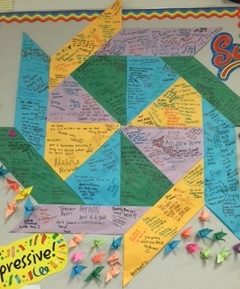
I've been doing this since my first year of teaching.  Came out of a site wide Math Expo event. During Math Expo, students would rotate to different classes and participate in a different math related activity. I would always facilitate the origami event. Before I got a document camera, I would use very large pieces of paper to model building a 8-pointed pinwheel. After, I would have these giant pinwheels. The idea of throwing them away made me sad, so I decided to repurpose them as my "yearbook". Here are some of them.